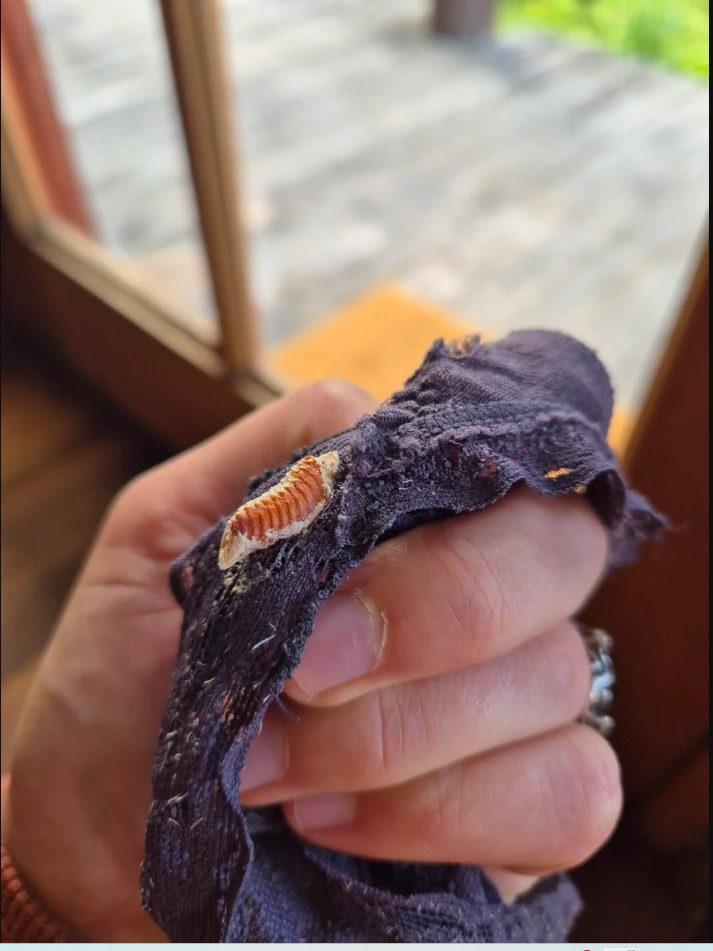
You’re in the middle of a dream trip, digging into your laundry bag for that one pair of reliable travel pants. You pull them out, and there, firmly cemented to the fabric, is a strange, tan-colored “pod.” It’s hard, ridged, and looks like a piece of dried expanding foam or a very organized bit of mud. You’ve been living out of a cotton bag for weeks—how did a “sculpture” end up on your zipper?
A traveler recently shared this exact discovery, sparking a mix of curiosity and “burn the bag” reactions. Embrace “Eco-Travel” and slow-paced exploration, finding this object is actually a sign of incredible timing. You aren’t looking at a stain or a fungus—you’ve been chosen as a high-speed transport for a Praying Mantis Ootheca. The Mantis Egg Case, the science of “Biological Styrofoam,” and the Nana Rule for why the best souvenirs are the ones that hatch.
1. The Reveal: What is an Ootheca?
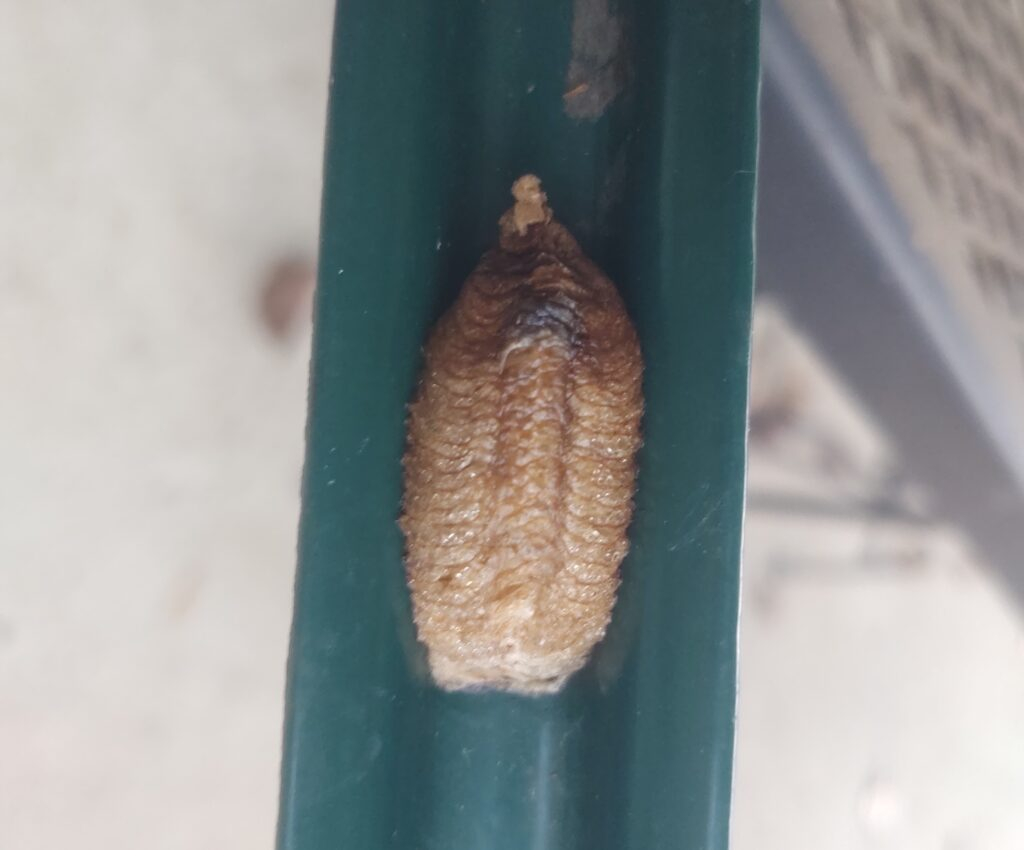
The object attached to the pants is an Ootheca—the protective egg case of a Praying Mantis.
The Production: A female mantis produces this frothy liquid that she whips into a foam with her abdomen. As it dries, it hardens into a tough, parchment-like material that is incredibly resistant to the elements.
The “Nursery”: Inside that one small pod, there can be anywhere from 50 to 200 tiny mantis nymphs waiting for the right temperature to emerge.
The Attachment: Mantises usually lay these on sturdy twigs or walls. In this “little-known” travel twist, the mantis likely found your cotton bag drying outside or in a quiet corner of a hostel and decided your pants were the sturdiest “branch” in the room.
2. The “Bio-Foam” Science: Why It Won’t Budge
Why is it so hard to pull off? Because mantis “glue” is a marvel of natural engineering.
Insulation Tech: The ootheca is designed to protect the eggs from freezing winters and scorching summers. It’s essentially a “Biological Styrofoam” that provides a stable internal temperature.
The Glue Secret: The adhesive the mantis uses to attach the case to your pants is waterproof and incredibly strong. If you pull it off roughly, you might actually tear the fibers of your clothes.
The “Wait” State: Mantis eggs often go into “diapause”—a state of suspended animation—meaning they can travel halfway across the world in your suitcase without hatching, waiting for the “spring” of your home destination.
3. Why This is the Ultimate “Green” Souvenir
Finding a mantis case is considered “Good Luck” in the sustainable travel community.
The Predator Advantage: Mantises are the “Apex Predators” of the garden. They eat everything from mosquitoes and flies to moths and even small grasshoppers.
The “Zero-Chemical” Fix: If these hatch in your home garden, you’ve just released a “little-known” army of natural pest controllers.
The Travel Story: Most people bring back magnets; you brought back a hundred future warriors for your backyard ecosystem.
4. How to Handle a “Traveler’s Ootheca”
If you find a pod on your gear, follow this “Relocation Protocol”:
Don’t Squeeze: The case is strong, but the eggs inside are delicate. Avoid pressing on the ridged center.
The “Slow Peel”: Use a thin, flat blade (like a butter knife) to gently slide under the edge of the case. Take your time to avoid ripping the cotton fabric.
The Garden Re-Homing: Once removed, don’t just throw it in the grass. Tie or tape it to a sturdy branch about 3-4 feet off the ground in a sunny spot.
The Hatch Watch: In late spring, look for dozens of tiny, 1cm-long “mini-mantises” emerging from the center seam.
5. Nana’s Wisdom: “A Guest with a Thousand Eyes is Still a Guest”
Nana lived near the fields and always welcomed the “Praying Ladies” into her garden. She didn’t have a suitcase, but she knew that nature always finds a way to hitch a ride.
She used to tell us, “You’re all making a fuss over a bit of brown foam! But that little lady saw your laundry and thought, ‘There’s a safe place for my children.’ In my day, we didn’t call it ‘scary’; we called it a ‘compliment.’ A guest with a thousand eyes is still a guest, child. You stop your ‘what is it’ and you start being careful with your zipper. If you’ve carried them this far, you’ve got a duty to see them to the finish line. A person who helps a mantis hatch is a person who’s going to have a garden with no flies and a heart with no regrets.” She believed that “magic” was just life being clever.
She’d see that photo and say, “Take a breath! You’ve found a nursery, not a mess. You peel it off like a scab—slow and steady—and you put it on the rosebush. You don’t need to ‘burn the bag’; you just need to realize that your trip was more important than you thought. You were a ‘little-known’ chariot for a hundred little souls. Now, go wash your pants and thank the Lord for the company.” Nana had a rule: The “Nursery” Rule. She’d say, “You never disturb a mother’s work unless you’re planning on doing it better yourself.” Nana knew that the real “intelligence” was just being a good host.
The Takeaway: The Accidental Guardian
The “Stitch” on your pants is a classic 2026 reminder that the world is much more “connected” than we think. It’s a “little-known” gift of natural pest control that decided to travel with you.
Be honor the “Suitcase Ootheca.” If you find one, don’t panic—just relocate it. Your garden will thank you in the spring.
Have you ever found a “biological hitchhiker” in your travel gear? Was it a mantis case, or did you accidentally transport something even more “little-known” across a border?