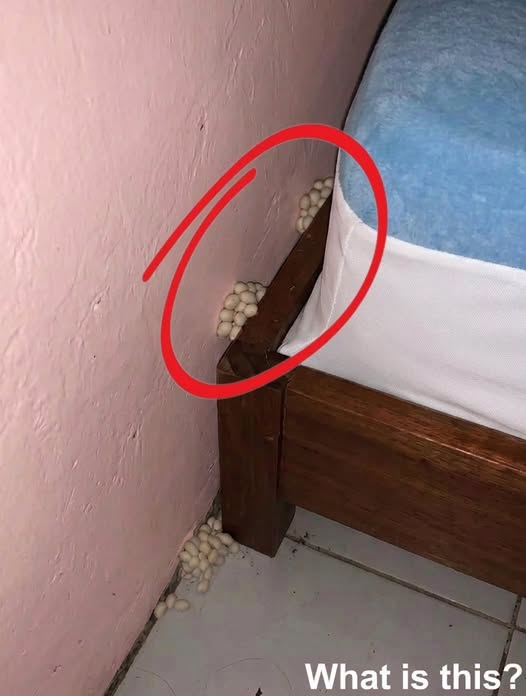
You’ve just finished a brutal shift at work. Your feet are aching, your eyes are heavy, and all you want to do is collapse onto your mattress and sleep for eight straight hours. You drop your keys, head into your room, and lean down to plug in your phone charger right behind your bed frame. But as you look into the narrow gap between the wooden headboard and the pink wall, your heart drops. Sitting there, piled neatly in tight, bumpy clusters, are dozens of tiny, smooth, cream-colored ovals. They look like mini reptile eggs or a strange, fungal growth.
A shocked homeowner recently shared this exact picture, asking: “I came home tired, saw this near my bed, and honestly got really scared. What on earth is this?” In 2026, as urban wildlife adapts closer to our living spaces, discovering these “hidden caches” is a viral trend. But you aren’t looking at a monster movie prop—you’re looking at a “little-known” signature of Gecko Eggs.
Here is the deep dive into the Bed Frame Nest, the science of “Sticky Shell Calcification,” and the Nana Rule for why finding life in your bedroom isn’t always a bad sign.
1. The Reveal: What are These White Pebbles?
The clusters tucked into the gaps around the bed frame are House Gecko Eggs (likely from the Common House Gecko or Mediterranean House Gecko).
The Sticky Shell: Unlike bird eggs, female geckos lay eggs that are soft and highly sticky when they first emerge. She deliberately presses them into hidden, tight vertical cracks—like the space between your bed and the baseboard. Within minutes, the shells calcify and “glue” themselves permanently to the wall and wood.
The Layered Strategy: Geckos are communal breeders. “Little-known” fact: multiple female geckos will often use the exact same hidden crevice to lay their eggs over several weeks, which is why you see separate, perfectly organized clusters piled on top of each other.
The Floor Spill: The small pile on the floor tile shows where older, hatched eggshells eventually lost their stickiness and fell down, or where a heavy vibration (like moving the bed) detached them from the plaster.
2. The 2026 Urban Ecosystem: Why Under Your Bed?
Why would a wild lizard choose your sleeping space to start a family? It’s all about the perfect 2026 microclimate.
Consistent Temperature: Ectothermic (cold-blooded) creatures look for stable environments. The gap behind a heavy wooden bed frame stays shielded from drafts and direct sunlight, keeping the eggs at a safe, warm temperature.
The Insect Buffet: Geckos live where their food lives. If your room has a tiny crack near the floor or window that lets in small gnats, ants, or silverfish, the geckos see your bedroom as a five-star restaurant with a safe nursery hidden behind the frame.
Safety from Predators: Outside, birds and larger lizards eat gecko eggs. Inside your room, packed into a tight wooden corner, the eggs are 100% safe from predators.
3. The “Hatchling” Timeline: Are They Empty?
If you look closely at gecko clusters, you can often tell if you have “roommates” already or if they are still waiting to arrive.
Hatched vs. Unhatched: Unhatched gecko eggs are solid, heavy white, and completely opaque. Once the baby gecko uses its tiny “egg tooth” to break out, the shell leaves a clean, hollow opening.
The Incubation Window: “Little-known” tip: Gecko eggs take anywhere from 40 to 60 days to hatch depending on the warmth of the room. If you leave them alone, a tiny, harmless lizard the size of a paperclip will emerge, instantly looking for bugs to eat.
The Clean Removal: Because the shells are glued with natural calcium, trying to pull an unhatched egg off the wall can easily break it. If they are already empty, you can gently scrape them off into a dustpan using a putty knife.
4. How to Handle Bedroom Wildlife in 2026
If you look behind your bed and see the white clusters, follow this simple homeowner protocol:
Don’t Panic: Geckos are completely non-venomous, harmless, and silent. They do not chew wood like termites, and they do not carry diseases that affect humans or pets.
Check for Openings: If you don’t want more lizard guests, trace the floor line behind your bed. Use a bit of silicone caulk to seal any small gaps where the wall meets the floor tiles.
Let Them Work: In 2026, many eco-conscious homeowners choose to leave house geckos alone. They act as a free, organic pest control service, keeping your bedroom clear of spiders, mosquitoes, and flies while you sleep.
5. Nana’s Wisdom: “A House with a Lizard is a House with No Mosquitoes”
Nana grew up in a house with a wraparound porch, and she treated the little wall lizards like part of the family. She always said that people who are afraid of a harmless gecko have forgotten how the world works.
She used to tell us, “You’re all screaming and jumping on the mattress because of a few little white stones! But in my day, we knew that a house with a lizard is a house with no mosquitoes. If that little creature chose the corner of your bed to lay her eggs, it means your room is warm, quiet, and safe. You stop your ‘getting scared’ and you leave those shells alone! A gecko doesn’t eat your blankets or borrow your clothes—she just sits in the dark and keeps the biting bugs off your face while you’re dreaming. A person who chases a gecko out of their bedroom is a person who’s going to be waking up with spider bites by next week.” She believed that nature’s helpers didn’t need to pay rent.
She’d look at that photo of the bed frame clusters and say, “Take a breath! Put your pillow back down and get some sleep. Those eggs are just a sign that life finds a way, even in the dust behind the headboard. You leave them be until they’re empty, then you take a little brush and sweep the old shells away. You don’t need to be a fancy scientist to know that a tiny lizard is a better roommate than a swarm of flies. You treat the small things with kindness, and the house will take care of you.” Nana had a rule: The “Wall” Rule. She’d say, “If it stays on the wall and eats the bugs, it’s a guest, not a pest.” Nana knew that in 2026, the real “intelligence” was just letting nature do its job.
The Takeaway: The Bedroom Helpers
The white clusters behind the bed aren’t a sign of a dirty room—they are a sign of a healthy, functioning home ecosystem. They are a “little-known” architectural wonder created by a small creature looking for safety, comfort, and a place to rest—just like you after a long day at work.
In 2026, let’s honor our “Hidden Roommates.” Next time you pull your bed away from the wall, check the corners. You might just find the quiet guardians of your sleep.
Be honest—if you looked behind your mattress tonight and saw a pile of white gecko eggs, would you sleep on the couch, or would you be happy to have the free pest control? Have you ever found a lizard nest hidden inside your house before? Let’s share our “Bedroom Mysteries” in the comments below—let’s talk about the life that shares our spaces!