A quiet school day turned into a situation that nobody could have predicted. What began as a confrontation between two teenagers quickly escalated into a dispute that would eventually find its way into a courtroom, raising difficult questions about responsibility, consequences, and where the line between self-defense and retaliation should be drawn.
The story centered around a 16-year-old student named Ethan. Friends described him as a relatively calm teenager who usually stayed out of trouble. He was known for focusing on sports and spending time with a close group of classmates.
On the other side of the dispute was another student, Tyler, who had developed a reputation for frequently challenging other students. While teachers had addressed concerns about his behavior before, many classmates felt that tensions often continued beyond the classroom.
One afternoon during a break between classes, a disagreement broke out near a gathering area behind the school gymnasium. Witnesses later described the atmosphere as tense, with several students gathering nearby to watch the argument unfold.
According to multiple accounts, the confrontation escalated when Tyler allegedly carried out a reckless act involving Ethan’s hair. The unexpected incident immediately caused panic among nearby students and drew the attention of staff members.
Several students later stated that Ethan appeared shocked and frightened by what had happened. The sudden nature of the event left many young witnesses struggling to process what they had just seen.
As emotions surged, Ethan reacted. What followed was a brief physical confrontation between the two teenagers before teachers and school security intervened. The encounter lasted only moments, but those moments would soon become the center of an intense legal dispute.
School officials separated both students and contacted their families. Medical evaluations were conducted, and administrators launched an internal investigation to determine exactly what had occurred.
In the days that followed, rumors spread throughout the community. Parents discussed the incident online, students debated what they had witnessed, and local residents expressed strong opinions about who was responsible.
Many people initially viewed Ethan as a teenager reacting to a frightening and stressful situation. Others argued that once the immediate danger had passed, any further physical response should have been avoided.
The school district attempted to remain neutral while gathering statements from students, staff members, and security personnel. Their goal was to establish a clear timeline without relying on speculation or emotional reactions.
As investigators reviewed witness accounts, the situation became increasingly complicated. Some students believed Ethan had acted instinctively in a moment of fear. Others felt that both teenagers had made poor decisions that contributed to the confrontation.
Parents on both sides became deeply involved. Meetings were held with school administrators, counselors, and legal representatives. What had started as a school disciplinary issue was quickly evolving into something much larger.
Several weeks later, news emerged that Tyler’s mother had filed a civil claim seeking significant financial damages. The amount immediately captured public attention and sparked heated discussions across social media platforms.
For many observers, the lawsuit transformed the narrative. Instead of focusing solely on the original incident, conversations shifted toward questions of accountability, parental responsibility, and the purpose of civil litigation.
Supporters of Ethan’s family argued that the teenager had been placed in a frightening situation and reacted emotionally. They believed the legal action unfairly ignored the circumstances leading up to the confrontation.
Meanwhile, supporters of Tyler’s family emphasized that regardless of what happened beforehand, physical confrontations can lead to serious consequences. They argued that every participant in such incidents must be held accountable for their actions.
The courtroom proceedings attracted widespread interest. Reporters, legal commentators, and members of the community closely followed each development.
During hearings, attorneys presented differing interpretations of the same event. One side focused heavily on the actions that triggered the confrontation, while the other emphasized the response that followed.
Witness testimony became a major factor. Students described the atmosphere before the incident, the reactions of those involved, and the sequence of events as they remembered them.
As is often the case, memories varied. Some witnesses recalled details differently, highlighting how difficult it can be to reconstruct emotionally charged situations with complete certainty.
Legal experts following the case noted that juries and judges frequently face similar challenges. Determining what happened is often only the first step. Deciding how responsibility should be distributed can be even more difficult.
Throughout the process, the emotional toll on both families became increasingly apparent. What had begun as a conflict between teenagers had expanded into a highly public dispute affecting parents, relatives, and friends.
Counselors working with students at the school reportedly encouraged open discussions about conflict resolution and emotional regulation. Many educators saw the incident as an opportunity to address broader concerns about student behavior.
The case also sparked conversations about how quickly ordinary disagreements can spiral into life-changing situations. A few impulsive decisions can create consequences that last far beyond a single afternoon.
Parents across the community expressed concern about the growing influence of online reactions. Social media users often formed opinions before all facts were known, creating additional pressure for everyone involved.
Meanwhile, both teenagers faced challenges returning to normal routines. Public attention made it difficult for either family to move forward while the dispute remained unresolved.
As months passed, legal arguments continued. Attorneys reviewed evidence, questioned witnesses, and attempted to persuade the court that their interpretation of events was the most accurate.
Observers noticed that the case had evolved beyond a simple disagreement about who was right or wrong. It had become a discussion about proportional responses, accountability, and the complexities of human behavior under stress.
Some legal analysts suggested that the outcome could influence how similar disputes are viewed in the future. Others cautioned against drawing broad conclusions from a highly unique set of circumstances.
Regardless of the final legal result, many community members agreed on one point: the situation was tragic for everyone involved. Two teenagers had become the focus of a dispute that neither likely imagined would reach such a scale.
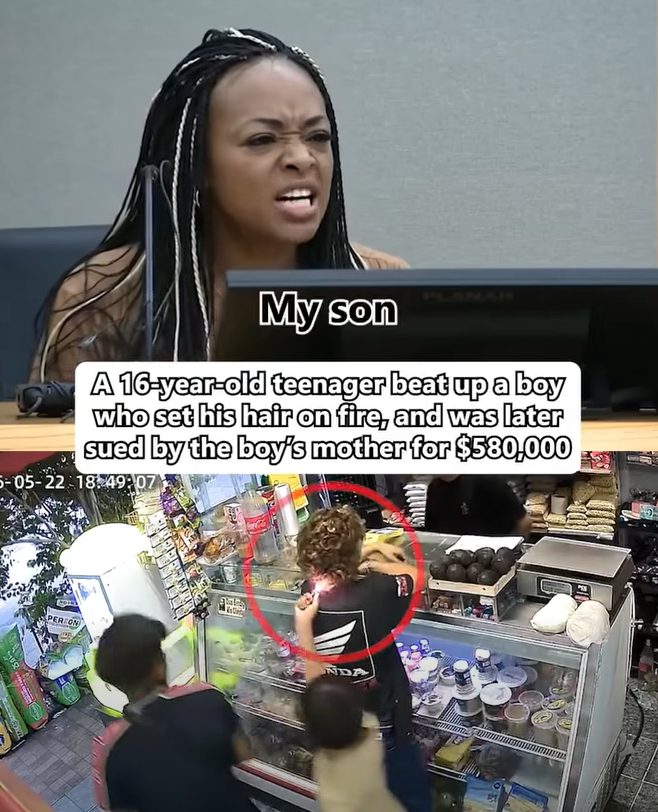
@gutre43 A 16-year-old teenager beat up a boy who set his hair on fire, and was later sued by the boy's mother for $580,000#news #usa🇺🇸 #crime #court #courtroom ♬ original sound – gutre43
Educators emphasized the importance of teaching young people healthier ways to respond to conflict. They argued that communication, intervention, and emotional awareness remain essential tools for preventing situations from escalating.
Parents echoed those sentiments. Many expressed hope that students could learn valuable lessons from the incident without experiencing similar hardships themselves.
In the end, the case served as a reminder that actions often create consequences extending far beyond the moment they occur. Decisions made in seconds can shape lives for months or even years.
What started as a tense encounter between two teenagers eventually became a story discussed throughout an entire community. While opinions remained divided, the incident encouraged important conversations about responsibility, judgment, and the challenges of navigating conflict during adolescence.
For many observers, the lasting lesson was not about who won or lost in court. Instead, it was about how quickly emotions can take control, how complicated accountability can become, and how important it is to think carefully before reacting in moments of intense pressure.
As the community continued to reflect on the events, one thing remained clear: everyone wished the original confrontation had never happened. Yet the discussions it inspired may ultimately help prevent similar situations in the future, making a difficult chapter a valuable lesson for generations of students to come.