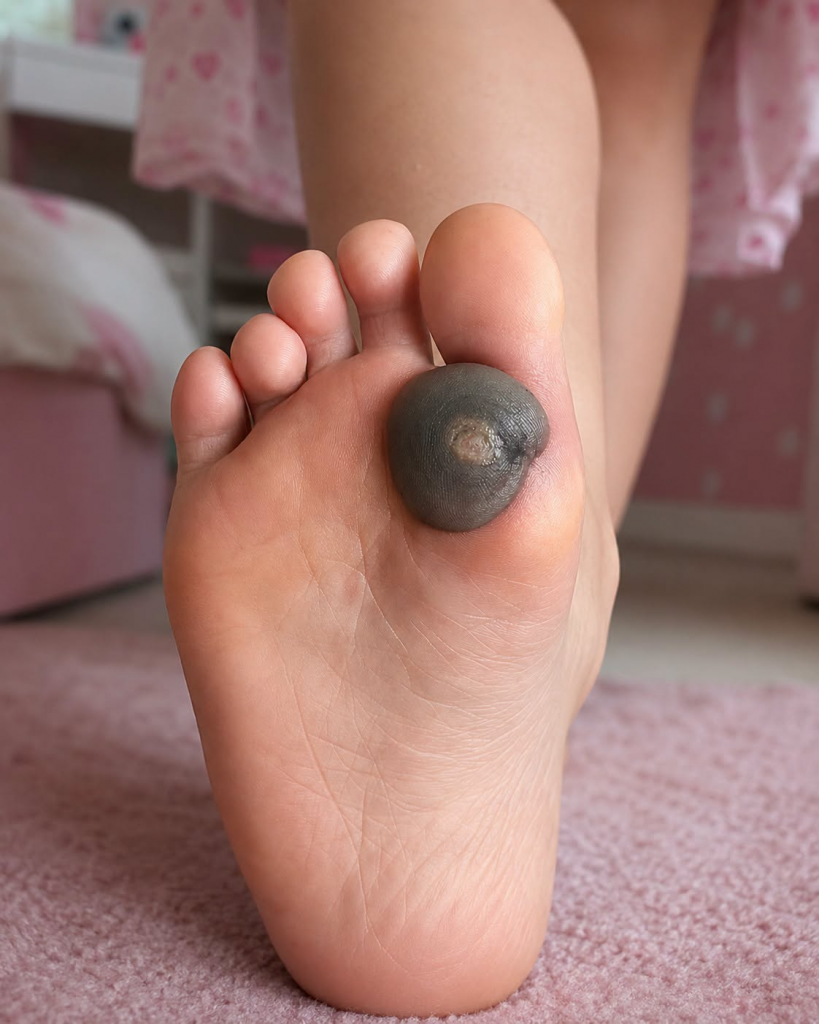
You walk into your child’s bedroom to wake them up for school, expecting the usual groggy morning complaints. Instead, your daughter is in tears, pointing down at the sole of her foot. Right on the ball of her foot, sitting beneath the skin like a dark gray, swollen marble, is a massive growth. She’s in sharp pain, she can’t bear weight, and she can’t even comfortably flex her toes. Your mind immediately races to worst-case scenarios: An exotic spider bite? A sudden infection? A bizarre tropical parasite?
A panicked parent recently shared this exact situation online, asking: “My daughter woke up with this huge spot on her foot. She’s been in pain and can’t move her foot, what is this?!”
While the dark, bulbous appearance looks absolutely terrifying at first sight, you aren’t looking at a rare disease. This is a severe, deep-tissue Blood Blister. Because of its location on a high-pressure zone of the foot, it can cause temporary structural immobility from the sheer internal fluid pressure.
Here is the deep dive into the Massive Plantar Blood Blister, the science of “Friction Vascular Rupture,” and the Nana Rule for why protecting the skin barrier is your absolute number-one priority.
1. The Reveal: Why Is It So Big and Dark?
A blood blister is fundamentally similar to a standard clear friction blister, but with a costly structural twist.
The Broken Pipe: When the skin experiences severe friction, pinching, or impact, the upper layers separate. If that trauma is deep enough to rupture the tiny, microscopic blood vessels (capillaries) in the dermal layer, blood leaks into the newly formed pocket instead of clear lymph fluid.
The Plantar Pressure Cooker: The skin on the sole of the foot is incredibly thick and tough. When blood pools there, the skin doesn’t stretch easily. This creates an intense, tight fluid bubble that presses directly against the deep nerve endings of the foot, causing throbbing pain and making it feel impossible to move or walk.
The Color Shift: The dark gray or purplish color isn’t a sign of necrosis or rot. It is simply pooled, deoxygenated blood trapped under a thick layer of translucent calloused skin. As it heals, it will gradually turn brown or black before peeling away.
2. The 2026 Common Culprits: How Did It Form Overnight?
Parents are often baffled because the child went to sleep with normal feet and woke up with a giant blister. It is a “little-known” fact that blood blisters can take several hours to fully inflate after the initial injury.
The Unadjusted Footwear: Did she wear new cleats, stiff dance shoes, or un-broken-in sneakers the evening before? A few hours of intense running or jumping with a small pebble or an unflattened seam inside the shoe can systematically grind the capillaries apart.
The Pinch Injury: She may have accidentally stepped hard on a small, raised toy (like a stray building block) or pinched the sole of her foot while pivoting sharply on a hard surface or playground structure.
The “Delayed Swell” Phase: The injury happens during afternoon play, but because the foot is constantly compressed by walking, the blood doesn’t pool fully until she lies down to sleep. With the pressure off her feet, the fluid freely expands overnight into the “marble” seen in the morning.
3. The “Hands-Off” Emergency Protocol
When a blister is this large and painful, your first instinct is to grab a needle and pop it to relieve the pressure. In 2026, medical guidance is stricter than ever: Do not pop it at home.
The Sterile Shield: The roof of that blister is a natural, airtight bandage keeping bacteria out. The sole of the foot is constantly exposed to floor dust, sweat, and shoe bacteria. Popping it leaves a raw, open crater that invites severe bacterial infections like cellulitis.
Managing the Pain: Instead of popping, manage the pressure by elevating the foot above the heart and applying a cold compress (a bag of ice wrapped in a thick towel) for 15 minutes at a time. This shrinks the blood vessels and numbs the throbbing nerve endings.
The “Doughnut” Padding: To help her move around without putting direct weight on the bubble, cut a hole out of a thick piece of moleskin or foam padding to create a “doughnut.” Stick it to her foot so the blister sits safely inside the empty center hole, protected from friction.
4. When to See a Professional in 2026
While standard blood blisters heal on their own within one to two weeks, a massive lesion that causes structural immobility requires a doctor’s evaluation. Seek care if:
The Pain Is Unmanageable: If she cannot move her foot or toes even after icing and elevation, the fluid pressure may need to be drained by a medical professional using sterile, clinical tools.
Red Streaks Appear: If you notice red lines traveling up her foot, increased warmth radiating from the spot, or leaking pus, these are immediate signs of an underlying infection.
Spontaneous Rupture: If the blister pops on its own, clean it immediately with mild soap and water, leave the overlying flap of skin intact to protect the raw base, apply an antibiotic ointment, and cover it securely with a sterile non-stick bandage.
5. Nana’s Wisdom: “A Bubble in the Skin is Nature’s Way of Locking the Front Door”
Nana had seen her share of blisters from decades of farm work and chasing children across gravel yards. She knew that the body’s weirdest reactions were usually just defensive shields.
She used to tell us, “You’re all running for the sewing basket with a needle like you’re trying to pop a balloon! But that dark pocket on the child’s foot isn’t a plaything—it’s a sanctuary. In my day, we knew that a bubble in the skin is just nature’s way of locking the front door while it fixes the pipes inside. If you go poking holes in that roof, you’re just letting the dirt into a clean room. You stop your ‘pinching’ and your ‘squeezing’ and you let that foot rest! If she can’t walk today, it means the good Lord wants her sitting on the sofa reading a book while her body cleans up the mess. A person who can’t leave a blister alone is a person who’s going to be crying over a swollen leg by Friday.” She believed that patience was the best ointment in the cabinet.
She’d look at that massive dark circle and say, “Take a breath! It looks like a nasty coal, but it’s just a pool of old blood keeping the raw skin safe underneath. You wrap that foot up in a clean, soft cloth, you keep her off her feet, and you let the ice do the talking. If the pain stays so sharp she can’t wiggle her toes by evening, you go on and let the doctor look at it—but you don’t go playing surgeon in the kitchen. Nature knows how to wash its own windows if you just give it some time.” Nana had a rule: The “Bubble” Rule. She’d say, “If skin grew a roof over it, you’ve got no business tearing the shingles off.” Nana knew that in 2026, the real “intelligence” was just letting the body heal itself in peace.
The Takeaway: The Body’s Emergency Brake
A giant blood blister on the sole of a foot is a dramatic sight, but it is ultimately a highly effective, natural defense mechanism. It acts as the body’s emergency brake, forcing your daughter to stay off her feet so the delicate tissue underneath can repair itself safely.
In 2026, let’s honor the “Sterile Shield.” Keep the area clean, protect it from pressure, and let time do the heavy lifting.
Have you or your kids ever woken up with a sudden, scary-looking blister after a long day of sports, or did you ever make the mistake of popping a blood blister too early? What’s your “little-known” secret for protecting sore feet during a hectic week? Let’s share our “First Aid Finds” in the comments below—let’s talk about how we keep our families moving safely!