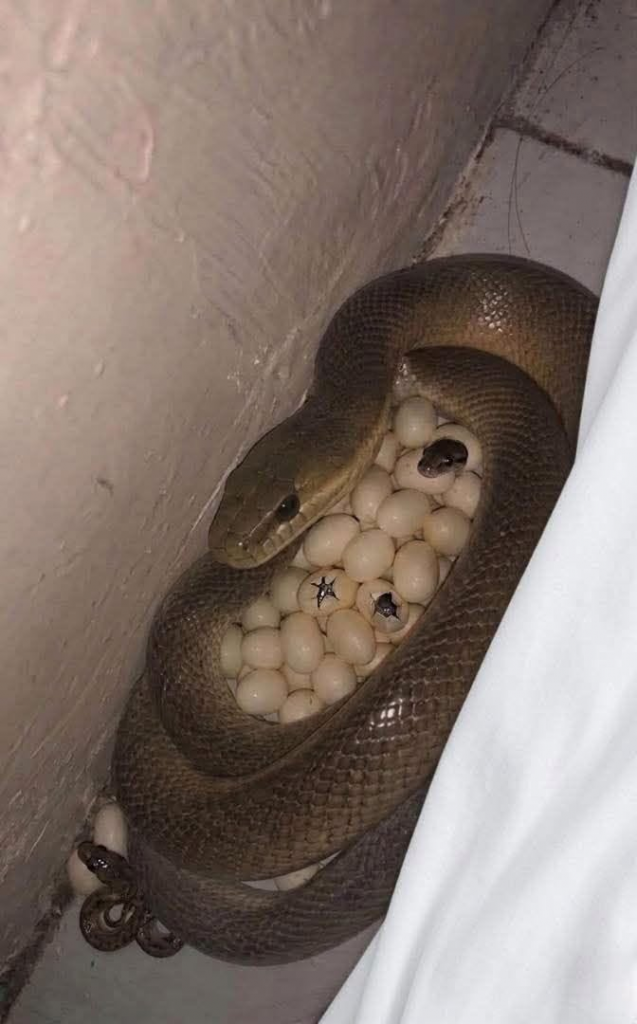
You open your eyes, stretch your arms, and prepare to roll out of bed to greet the day. As your feet swing toward the floor, you glance down into that narrow, dusty gap between your mattress and the wall. Your body instantly goes rigid. Coiled tightly in the corner, wrapping its heavy, scaled body around a massive pile of leathery white eggs, is a large snake. To make matters worse, a tiny, dark head is already poking out of one of the shells.
A homeowner recently captured this exact heart-stopping scene, asking the internet: “What would you do if you woke up in the morning and saw this beside your bed?” In 2026, as urban expansion pushes wildlife into residential neighborhoods, encounters with nesting reptiles are becoming a viral reality. But while your first instinct might be to scream or run for a broom, this image reveals a “little-known” biological marvel: you are looking at a brooding Python, one of the few snakes in the world that exhibits fierce, dedicated maternal care.
Here is the deep dive into the Bedside Python Nest, the science of “Shivering Thermogenesis,” and the Nana Rule for why a mother protecting her babies—no matter how many legs she has—demands absolute space.
1. The Reveal: A Snake That Stays with Her Eggs
The reptile coiled behind the bed is a python (likely a Children’s Python or a similar non-venomous constrictor species).
The Leather Shells: Unlike the hard, brittle eggs of birds, snake eggs are soft, leathery, and prone to drying out. They stick together in a massive clump to minimize the surface area exposed to the air, preserving vital moisture.
The Hatching Stars: If you look closely at the photo, you can see star-shaped cracks in some of the eggs, with tiny snake heads peeking out. Baby snakes use a specialized, razor-sharp temporary tooth called an egg tooth to slice through the tough leather membrane from the inside out.
The Protective Coil: Most snakes lay their eggs and immediately abandon them. Pythons are a “little-known” exception. The mother will wrap her entire body around the clutch, refusing to leave even to hunt, until every single egg has hatched.
2. The 2026 Science of “Shivering Thermogenesis”
How does a cold-blooded animal keep her babies warm behind a wooden bed frame? The answer is a brilliant piece of biological engineering.
Incubation Shivering: Pythons cannot generate internal body heat like humans do. However, when a female python is brooding eggs, she will twitch and contract her powerful muscles in rhythmic spasms.
The Heat Engine: This “shivering” raises her body temperature by several degrees above the surrounding room air. By tightly coiling around the clutch, she transfers this metabolic heat directly to the eggs, acting as a living incubator in a cold bedroom.
The Bedroom Selection: Pythons look for tight, dark, humid spaces to nest. The gap between a mattress and a wall mimics a perfect subterranean hollow or a fallen log, offering protection from drafts and stabilization of humidity.
3. The Reality Check: What Should You Actually Do?
If you find yourself sharing a bedroom with a nesting python, follow this emergency wildlife protocol:
Do NOT Attack Her: Pythons are non-venomous constrictors, meaning they have no venom. However, a brooding mother is highly defensive. Attempting to poke her with a stick or a broom will provoke a lightning-fast strike and a painful bite.
Back Out Slowly: Pythons do not want to hunt humans. She is only in your bedroom because she found a safe spot for her clutch. Keep your pets away, leave the room, and close the door behind you.
Call a Wildlife Relocator: In 2026, standard pest control isn’t enough. You need a specialized reptile handler. They will carefully move the mother and the fragile, hatching eggs together into a secure transport container so the family can be safely released into the wild.
4. Why the “Hatchlings” on the Floor are the Real Timer
When you see baby snakes actively emerging from the shell, the situation becomes time-sensitive.
The Dispersal Phase: Once the baby snakes completely exit the egg, they will quickly crawl away from the mother to find tiny crevices to hide in.
The Food Chain: Tiny hatchlings feed on geckos, mice, and insects. If they escape into your floorboards or baseboards, finding them becomes ten times harder. Calling a handler while they are still in the coil is crucial to containing the entire nest.
5. Nana’s Wisdom: “A Mother with Scales is Still a Mother, and She Ain’t Looking for a Fight”
Nana lived near the swamps where black snakes and racers would occasionally nest under the chicken coop. She had a “little-known” respect for the maternal instincts of the wild, and she never tolerated anyone acting out of blind fear.
She used to tell us, “You’re all screaming and carrying on like the devil himself is under the mattress! But you look at that old girl—she’s just wrapping her body around her babies to keep them warm in a house that’s too cold for them. In my day, we knew that a mother with scales is still a mother, and she ain’t looking for a fight unless you bring it to her doorstep. You stop your ‘grabbing the shovel’ and you back right out of that room! A person who tries to hurt a creature that’s just defending her young is a person who’s missing a piece of their own heart. You let the snake men handle it, and you thank your stars she kept the rats out of your walls while she was hiding there.” She believed that every creature deserved a safe birth.
She’d look at that bedside coil and say, “Take a breath! It’s a shock to see first thing in the morning, sure, but she’s just looking for a dark corner to finish her work. Those little babies poking their noses out don’t want anything to do with you—they’re just looking for the sun. You close that bedroom door, you make your phone call, and you let the experts carry that whole family back to the woods where they belong. Nature doesn’t make mistakes, child—it just finds a way inside when we leave the back door unlatched.” Nana had a rule: The “Nesting” Rule. She’d say, “If it’s sitting on eggs, you give it the room. Respect the cradle, no matter who’s rocking it.” Nana knew that in 2026, the real “intelligence” was just letting peace rule the house.
The Takeaway: The Bedroom Sanctuary
Discovering a python nest beside your bed is the ultimate test of modern neighborly coexistence. It’s an intimidating, surreal sight, but it is also a beautiful demonstration of nature’s maternal devotion happening right on your floor tiles.
In 2026, let’s honor the “Safe Extraction.” Give the mother her space, protect the hatchlings, and leave the removal to the professionals.
Be honest—if you looked down tomorrow morning and saw a python hatching her eggs right next to your slippers, would you freeze in terror, or would you grab your camera before calling wildlife rescue? Have you ever found a “hidden wild family” inside your home before? Let’s share our “Wildlife Encounters” in the comments below—let’s talk about the wild spaces that touch our lives!