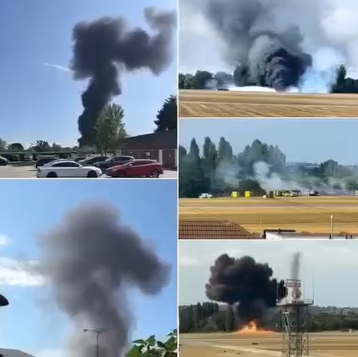
The video provides a comprehensive visual record of a significant aircraft crash and the subsequent emergency response, presented through a multi-panel collage. The opening frames immediately draw attention to a massive, dark plume of thick smoke ascending high into the clear sky. This ominous cloud originates from a specific point on or very near an active airport runway, indicating the location of the incident. Several different perspectives are combined in the layout to capture the unfolding disaster from multiple vantage points. In the upper left panel, the towering smoke plume stands out against the blue sky above a parking area where several cars are parked. The other panels zoom in closer to the crash site, revealing the intense activity on the ground as emergency services mobilize. A central panel shows a yellow vehicle and other emergency responders stationed on the grass, navigating near the area where smoke is actively billowing. The landscape consists of a dry, grassy airfield stretching out towards a distant line of trees that frame the horizon. Each segment of the collage serves to illustrate the scale and severity of the emergency, highlighting the immediate dangers present. Another frame captures a wide, dramatic shot of the smoke cloud as it reaches its peak height, dominating the airfield landscape. The presence of structural equipment and communication towers on the airfield further emphasizes that this is a controlled, high-stakes environment. Emergency vehicles can be seen maneuvering with urgency across the runway’s grassy perimeter to address the fire. The visual contrast between the bright, sunny day and the heavy, black smoke creates a stark and sobering visual narrative. Throughout the video, the persistent smoke plume acts as the focal point, drawing the viewer’s eye to the center of the tragedy. The composition effectively integrates close-up shots of the wreckage area with wider, environmental views of the airport. This combination allows the viewer to grasp both the immediate impact and the broader context of the incident. The rapid development of the smoke indicates an active fire that required immediate and professional intervention. As the video progresses, the intensity of the smoke seems to fluctuate, reflecting the efforts of the responders below. The footage serves as a critical documentary-style piece, capturing an unexpected and dangerous event as it unfolded. Every panel is synchronized to give a cohesive sense of the chaotic scene at the airfield. The viewer is left with a strong impression of the complexity and rapid response required during aviation emergencies. The clarity of the images makes the scene feel very immediate and powerful. The parking lot scene provides a sense of distance between the general public area and the restricted airfield zone. The video successfully documents the coordination efforts between different emergency units as they converge on the site. The structural elements, like the communication tower in the lower right, give a sense of scale to the massive smoke plume. Each panel provides a unique perspective that contributes to the full story of the aircraft accident. The video maintains a steady pace, allowing the viewer to absorb all the different layers of information present. It does not provide any audio, yet the visual impact is overwhelming due to the clarity and composition of the scenes. The layout is well-organized, ensuring that the transition between the general view and the specific incident is seamless. The overall effect is one of extreme urgency, characteristic of a high-pressure emergency situation. The video demonstrates how complex environments like airports must be prepared for such devastating events. The dark smoke is clearly visible for miles, highlighting the magnitude of the fire. This record is a clear example of how video can preserve a moment of crisis in a professional and informative manner. The entire sequence ends with the smoke still rising, signaling that the response operation is still ongoing. The viewer feels the gravity of the situation through the lens of the stationary camera. No people are clearly identifiable in the footage, focusing instead on the larger machinery and the fire itself. This creates a more objective, almost scientific look at the aftermath of the crash. The video is a testament to the unpredictable nature of aviation safety. It highlights the importance of fast response times by emergency teams in such critical moments. The visual narrative is compelling, keeping the viewer’s interest anchored to the fire response. The contrast between the peaceful, bright sky and the violent fire is a recurring theme. The footage is brief, but it packs a heavy emotional punch because of the gravity of its subject matter. The multi-panel approach prevents the viewer from losing focus by showing multiple aspects of the disaster at once. It is a powerful example of visual storytelling in news or archival contexts. The video remains professional and direct, avoiding unnecessary drama while presenting the facts clearly. The final frames leave a lasting impression of the resilience and speed of the airport’s rescue services. It is a document of a difficult and intense moment, forever preserved in this visual record.