The boundaries of police authority and the necessity of structural restraint have once again taken center stage following a highly publicized legal resolution. A former law enforcement officer has received a criminal sentence after a booking room confrontation left a handcuffed woman severely injured.
@user372928485677 #fyp #news #breakingnews #crime #truecrime ♬ original sound – Yolo_aby
The incident, which was captured in vivid detail on facility surveillance cameras, has ignited widespread public discussion regarding the proportional use of force. This case highlights the critical role that internal and external monitoring systems play in upholding the integrity of the judicial system.
Legal experts and community advocates are analyzing the specific conditions surrounding the arrest and subsequent booking procedures. The case underscores a growing national dialogue about accountability for law enforcement professionals who cross established professional lines.
The event began late on a December evening when patrol officers initiated a routine traffic stop following a multi-vehicle collision. The driver, identified as Shanna McCree, was suspected of operating her vehicle under the influence of alcohol after failing initial roadside tests.
The atmosphere during the initial roadside contact was described by responding personnel as increasingly tense and verbally adversarial. McCree allegedly expressed vehement dissatisfaction with the officers’ intervention, questioning the legal basis of her detention and using profane language.
Following standard operating procedures for suspected impaired driving, officers placed McCree in handcuffs and transported her directly to the local police department. The responsibility for securing the transport and managing the intake fell on two specific officers assigned to the shift.
Officer Jacob Bryan Cannon, a 32-year-old department veteran, alongside Officer Melissa Edmonds, escorted the detainee into the facility’s secure processing area. Throughout the transit process, the verbal friction between the detainee and the escorting staff continued to intensify significantly.
Upon entering the booking room, McCree was initially instructed to sit in a designated intake chair while paperwork was prepared. The environment inside the processing area is tightly controlled, designed specifically to minimize risk and ensure both officer and detainee safety.
Surveillance footage shows McCree continuing her loud verbal protests, adamantly declaring that she did not recognize the legal authority of the officers. Her resistance remained predominantly vocal during the initial fifteen to twenty minutes of her confinement within the room.
The situation reached a critical inflection point when the officers attempted to administer a secondary breath-testing sequence. McCree repeatedly disrupted the testing process, demanding immediate access to the restroom facilities before completing the required breath analysis.
Officer Edmonds informed the detainee that standard protocol required the completion of the intake tests prior to removing restraints. According to department guidelines, handcuffs are generally maintained during active testing sequences to prevent any sudden physical interference with the machinery.
McCree initially complied with two separate attempts to provide a breath sample into the specialized testing unit. However, the testing apparatus failed to register a valid diagnostic reading, likely due to insufficient air volume or technical error.
The repeated technical failure of the machine exacerbated the frustration of everyone involved in the small processing room. The detainee began to experience a visible emotional breakdown, expressing intense anxiety regarding her prolonged physical restraint and unmet basic needs.
Following the invalid test results, Officer Cannon engaged in a sharp verbal exchange with McCree regarding her compliance levels. The dialogue rapidly deteriorated from structured professional commands into a heated personal dispute, visibly escalating the emotional stakes.
McCree adamantly refused to participate in a third testing attempt, citing the previous failures and demanding immediate legal representation. The physical proximity of the officer to the restrained detainee increased, creating a highly volatile spatial dynamic inside the office.
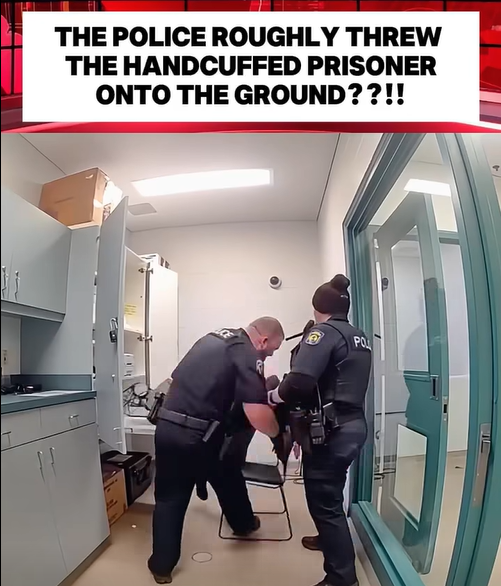
The situation escalated into physical violence when Officer Cannon sought to re-secure McCree’s position near the processing desk. The surveillance video captures the officer utilizing a sudden and highly aggressive physical maneuver to subdue the non-compliant detainee.
With her hands securely cuffed behind her back, McCree possessed no capacity to break her fall or protect her upper body. The officer forcefully threw her toward the floor, causing her head to strike the rigid surface of the ground.
The impact resulted in an immediate and severe laceration across McCree’s forehead, accompanied by significant distress and bleeding. The sudden deployment of such extreme force caused Officer Edmonds to immediately intervene and attempt to de-escalate the scene.
Recognizing the severity of the injury, facility staff immediately requested emergency medical technicians to report to the booking area. McCree was subsequently transported to a local medical center, where physicians administered seven stitches to close the deep facial wound.
In the immediate aftermath of the physical confrontation, Officer Cannon filed an official use-of-force report detailing his perspective. He maintained that his actions were a necessary and proportional response to a perceived active escape attempt by the detainee.
The written report asserted that McCree had attempted to manipulate her handcuffs and leverage her body weight to flee custody. This official narrative, however, was quickly subjected to rigorous internal review as department supervisors initiated a formal investigation.
Internal affairs investigators conducted an exhaustive review of the digital surveillance logs, comparing the footage directly with the written statements. The objective video evidence contradicted the claim that the restrained individual posed an active escape threat or a physical danger.
The investigative findings indicated that while McCree was verbally abusive and uncooperative, her physical actions did not warrant a takedown maneuver. The sheer disparity in size and leverage between the officer and the restrained woman became a focal point of the inquiry.
Faced with the impending results of the internal investigation and potential termination, Officer Cannon chose to resign from the force. His separation from the police department did not, however, shield him from the broader legal consequences of the booking room incident.
The state’s attorney office reviewed the independent investigative file and determined that the use of force crossed the threshold into criminal conduct. Cannon was subsequently arrested and officially charged with a count of serious felony assault under state law.
During the court proceedings, the prosecution leaned heavily on the objective reality presented by the facility’s internal cameras. Legal experts argued that throwing a fully restrained individual to the floor violates the core tenets of professional law enforcement training.
The defense sought to highlight the high-stress nature of the booking environment and the cumulative impact of the detainee’s verbal hostility. They argued that the officer’s actions, though regrettable in hindsight, occurred during a split-second assessment of a resisting subject.
The presiding judge rejected the defense’s request for complete leniency, emphasizing the absolute duty of care officers owe to individuals in custody. The court sentenced the former officer to six months of active incarceration, followed by two years of supervised probation.
The judicial decision has drawn mixed reactions from the local community and law enforcement associations across the country. Some advocacy groups view the active jail sentence as a meaningful step toward curbing excessive force within correctional environments.
Conversely, some commentators have questioned whether a six-month sentence provides sufficient deterrence for actions that cause severe bodily harm. The debate continues to highlight the complex legal standards used to evaluate police conduct during administrative processing.
This case serves as a stark reminder of how rapidly verbal non-compliance can escalate into permanent legal and physical consequences. The presence of functional, unedited surveillance video remains the single most critical factor in determining the truth of these encounters.