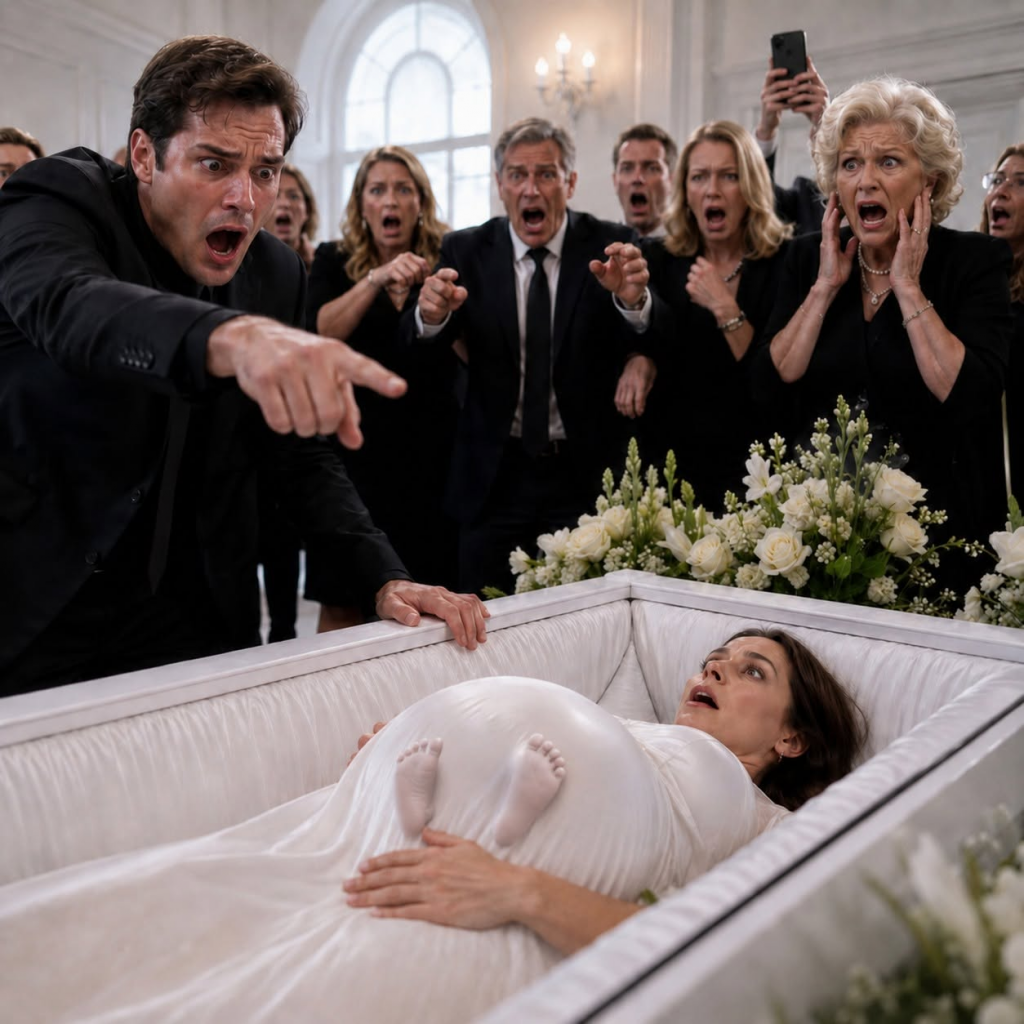
My dead wife moved inside her coffin. Not her hand, not her lips—her belly.
For three seconds, the funeral home froze around me like a photograph. White lilies trembled near the bronze casket. My mother-in-law’s sobs stopped mid-breath. My brother-in-law, Darren, lowered his phone from his face. And I, Nathan Hale, the grieving husband everyone had spent two days calling weak, unstable, and “too emotional to make decisions,” stared at my wife’s eight-month pregnant body and felt the world tilt.
“Just… let me see her one last time,” I had whispered only moments earlier.
They had almost refused me.
“She looks peaceful,” Marianne, my wife’s mother, had said, blocking the casket with her black lace sleeve. “Don’t ruin this with another breakdown.”
Darren had smirked beside her. “Let the professionals handle it, Nate. You already failed at handling Emma alive.”
That line had cut deeper than any knife.
Emma had collapsed at home forty-eight hours earlier after drinking the herbal tonic Marianne insisted would “help the baby settle.” The hospital called it cardiac arrest. The doctor on duty signed the papers too quickly. Marianne arranged the funeral too fast. Darren pushed cremation so aggressively that even through my grief, something in me had gone cold.
But I did not scream. I did not accuse. I let them think I was broken.
Because before I married Emma, I had spent twelve years as a forensic accountant for federal insurance fraud cases. I knew how greedy people moved money before they moved bodies. And the night Emma died, I had found three things: a deleted email from Marianne to a private doctor, a new life insurance policy taken out on Emma without her knowledge, and security footage from our kitchen showing Darren slipping something into that tonic bottle.
I had already sent copies to my attorney, a detective I trusted, and a private medical examiner.
Now Emma’s belly shifted again.
This time everyone saw it.
A scream tore through the chapel.
“Call the doctors—NOW!” I shouted, already climbing over the velvet rope.
Marianne’s face went white.
Darren grabbed my arm. “She’s dead, man. Stop.”
I looked at his hand on me, then at his eyes.
“Touch me again,” I said quietly, “and this funeral becomes your arrest scene.”
Part 2
The ambulance arrived in six minutes, but it felt like six lifetimes. I rode beside the casket as paramedics cut away the lining and checked Emma’s vitals.
“Pulse is faint,” one of them said, stunned. “Fetal movement confirmed.”
My knees nearly gave out.
Emma was alive.
Barely.
At the hospital, doctors rushed her into emergency care while I stood in the hallway with dried funeral dust on my suit and rage burning so cleanly inside me it felt almost calm. Marianne arrived fifteen minutes later, crying loudly for witnesses.
“My poor daughter,” she wailed. “My poor grandbaby.”
Darren stood behind her, arms crossed, pretending concern while his eyes kept flicking toward the police officer near the nurses’ desk.
They thought grief had made me dangerous.
They had no idea grief had made me precise.
A detective named Ruiz arrived before midnight. I handed him a folder.
“What’s this?” he asked.
“Everything they thought I wouldn’t notice.”
Inside were bank transfers from Emma’s trust account to Darren’s failing investment company. A forged signature authorizing Marianne as medical proxy. The insurance policy naming Marianne and Darren as beneficiaries if both Emma and the baby died. The kitchen footage. The pharmacy receipt for a compound that could mimic cardiac failure in certain doses.
Ruiz read in silence. Then he looked at me differently.
“You sat on this?”
“I waited until they acted recklessly.”
He glanced toward Marianne, who was now telling a nurse that I had been “emotionally abusive” and “obsessed with controlling Emma’s body.”
“She’s trying to build a story,” Ruiz said.
“She’s been building one for months.”
Emma had told me Marianne wanted access to her inheritance. Darren needed money after losing millions in a crypto scheme. When Emma refused to fund him, Marianne called her selfish. When Emma changed her will to leave everything to our child, they suddenly became devoted family again.
The strong reveal came at 2:17 a.m.
A doctor entered the waiting room.
“Your wife is in a medically fragile state,” she said. “But the baby’s heartbeat is strong. We also found sedatives in her bloodstream at levels inconsistent with hospital records.”
Marianne made a choking sound.
Darren snapped, “That doesn’t prove anything.”
I turned to him. “No. But your text to your mother does.”
His smirk vanished.
I held up my phone and read aloud. “After the tonic, keep Nate away from her. Once cremated, nothing can be tested.”
Marianne lunged forward. “You hacked us!”
“No,” I said. “Emma backed up your family group chat to our shared tablet. She was scared of you.”
Ruiz stepped between us.
Darren started sweating.
“You targeted the wrong woman,” I said. “And you underestimated the wrong husband.”
Part 3
At dawn, Emma opened her eyes.
She could not speak at first, only squeeze my fingers. I leaned close as tears finally broke loose.
“You came back,” I whispered.
Her lips trembled. “Baby?”
“Strong,” I said. “Just like you.”
For the first time in three days, I breathed.
The arrests happened two hours later.
Marianne tried to perform grief for the hospital corridor. “This is a misunderstanding! I am her mother!”
Emma’s eyes sharpened from the bed.
“No,” she whispered, voice rough but clear enough for everyone to hear. “You tried to make me a coffin.”
The hallway fell silent.
Darren cursed and shoved a chair, but Ruiz had him pinned before he reached the elevators. Marianne screamed that I had manipulated Emma, that I wanted her money, that I had staged the coffin movement somehow. But the evidence did not care about her tears.
The private medical examiner confirmed what the funeral home never checked properly: Emma had been placed into the casket while in a state of drug-induced suspended consciousness, her heartbeat too weak for careless equipment to catch. The hospital doctor who signed her death certificate admitted he had been pressured by Marianne’s private physician, who had also received a payment from Darren’s company.
Everything unraveled quickly after that.
Insurance fraud. Attempted murder. Conspiracy. Forgery. Elder financial abuse against Emma’s late grandmother’s estate. Obstruction. Evidence tampering.
Marianne’s pearls and black lace could not save her. Darren’s expensive watch could not save him. Their friends vanished. Their lawyers stopped smiling after the toxicology report came back.
At trial, the prosecution played the kitchen footage first.
Then they played the chapel footage.
The jury watched me bend over my wife’s coffin, watched her belly move, watched Marianne step backward not in shock—but in fear. That single reaction destroyed her.
When I took the stand, Darren’s attorney tried to paint me as unstable.
“You waited,” he said. “You gathered evidence instead of immediately accusing them. Isn’t that calculated?”
I looked at Emma, sitting in the front row with our daughter sleeping against her chest.
“Yes,” I said. “Because my wife taught me that panic helps predators. Patience catches them.”
Marianne was sentenced to twenty-eight years. Darren received thirty-five. The doctor lost his license before his own criminal case began.
Six months later, Emma and I stood in our backyard beneath soft spring light. Our daughter, Lily, slept in my arms, tiny fingers curled around my thumb.
Emma touched the scar where the IV had bruised her wrist.
“Do you ever think about that coffin?” she asked.
I looked at our child, alive because her mother had fought from the edge of death.
“No,” I said. “I think about the moment after.”
Emma smiled.
Behind us, the house was quiet, debt-free, and ours. Her mother’s name had been stripped from every document. Darren’s company was gone. The stolen money had been recovered into Lily’s trust.
For once, no one was performing grief.
No one was whispering lies.
There was only morning, our daughter breathing softly, and Emma’s hand warm in mine.
They had buried her too soon.
They had buried themselves instead.