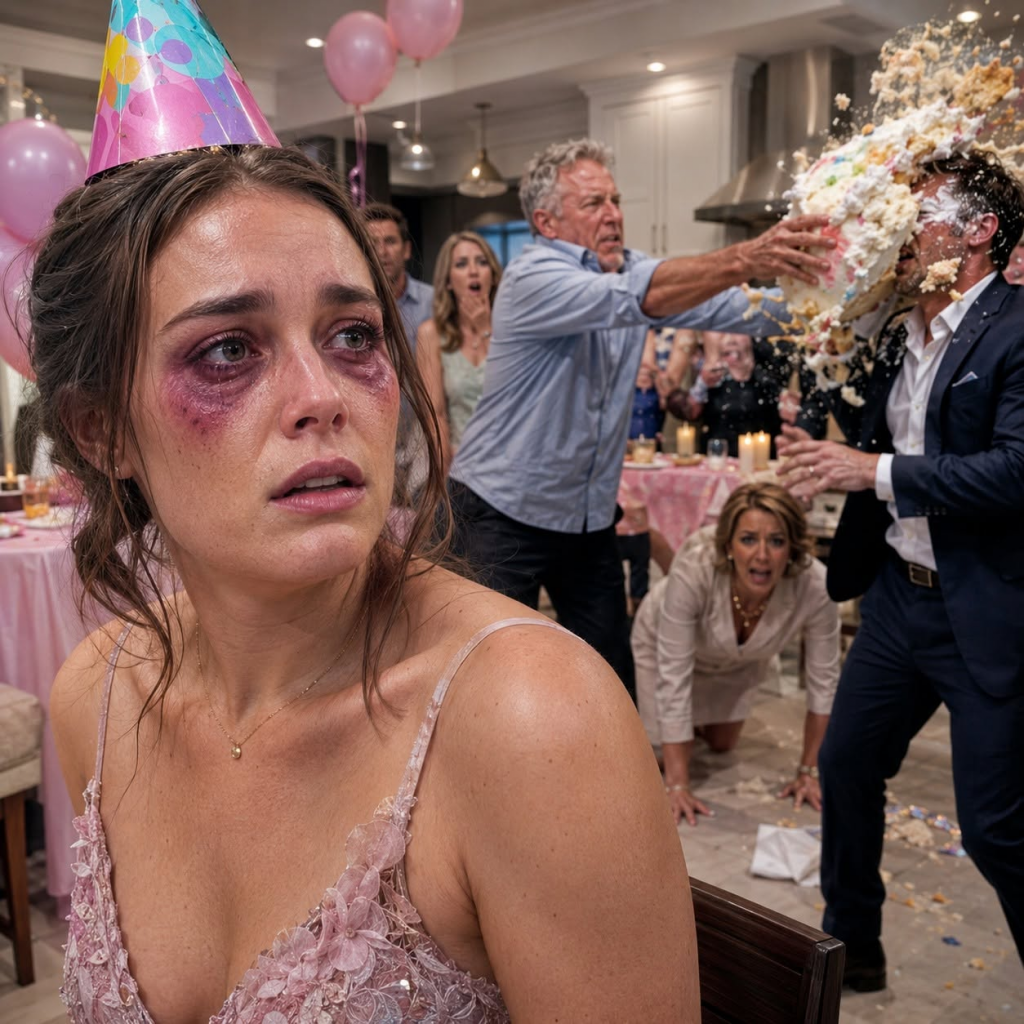
“Sweetheart… why is your face covered in bruises?” my father asked the second he walked into my birthday party. The room went so quiet that even the knife in my husband’s hand stopped halfway through the cake.
I touched my cheek like I had forgotten the purple fingerprints blooming there.
Before I could speak, Ryan leaned against the counter and smirked. “Yeah, that was me. I slapped her instead of saying happy birthday.”
His friends laughed first. Then his mother, Marlene, gave a delicate little gasp that was not shock, but performance.
“Ryan,” she scolded softly, “don’t make jokes like that. People misunderstand.”
But my father did not misunderstand anything.
Daniel Cross had raised me alone after my mother died. He was not a loud man. He had never been the father who broke doors or threatened boys on porches. He had spent thirty years as a prosecutor, turning monsters into case numbers and case numbers into prison sentences. When he was angry, his voice got lower, not higher.
He looked at me once. Not at the bruises. At my eyes.
I gave the smallest nod.
Ryan missed it. Marlene missed it. Everyone missed it because they had always believed I was the fragile wife who apologized when someone else cut her. They had spent a year training me to smile through insults, to call control “concern,” to wear long sleeves in July. Tonight, Ryan had invited people not to celebrate me, but to prove I would bleed quietly in public.
My father slowly removed his watch and placed it on the hall table.
Then he said, “Go outside. Now.”
My lungs forgot how to work.
“Daddy—”
“Outside, Ava.”
Ryan barked a laugh. “What is this, some cowboy scene? She’s my wife. She stays where I tell her.”
My father turned his head slightly. “You just confessed to assaulting my daughter in front of eleven witnesses.”
Ryan’s smile twitched.
Marlene stepped between them, diamonds flashing at her throat. “This family handles private matters privately.”
“Not anymore,” my father said.
I walked out through the patio door on shaking legs. The August sun hit my face, too bright, too clean. Behind me, inside the kitchen, my birthday balloons floated above the granite island like stupid pastel ghosts.
Through the kitchen window, I saw my father take one step toward Ryan.
Then I saw Marlene’s confident face collapse.
She dropped to her knees, crawled toward the back door first, and suddenly I understood.
My father had not come alone.
Part 2
Two plainclothes detectives stepped into the kitchen from the hallway, badges open, calm. Behind them came a woman from the county domestic violence unit, the same woman who had helped me sign an emergency safety plan three days earlier under the name “A. Morgan,” my mother’s maiden name.
Ryan’s mouth opened, but nothing came out.
Marlene crawled because she had been trying to reach the trash cabinet, where she had stuffed the torn envelope from the bank. She thought no one had noticed her shove it there when my father asked about my bruises.
I had noticed.
I had noticed everything for six months.
The first slap came after Ryan found out my mother had left me a quiet inheritance in a trust he could not touch. The second came after I refused to refinance the house my father bought before the wedding and Ryan pretended was his. By the time he hit me on my birthday morning, I already had photographs, medical records, audio recordings, and copies of every credit card Marlene had opened using my Social Security number.
I hid them in a folder called Recipes and mailed a duplicate drive to my father. Tonight was the last piece. Ryan loved an audience. I knew he would brag if humiliation made him feel powerful.
They thought my silence was surrender.
It was evidence collection.
From the patio, I watched Detective Harris lift the envelope from the trash with gloved fingers. Inside were copies of my forged signature on a loan application. Marlene made a sound like a kettle dying.
Ryan recovered faster. Arrogance was his survival instinct.
“This is insane,” he snapped. “Ava is unstable. Ask anyone. She falls, she cries, she forgets things.”
My father’s face did not change. “That is why the hospital photographed her injuries. That is why her therapist documented coercive control. That is why your neighbor’s security camera shows you dragging her back inside last Friday.”
Ryan looked toward the patio.
I did not look away.
For the first time in our marriage, he seemed afraid of me.
Marlene gripped the chair leg, still on the floor. “She set us up.”
“No,” the advocate said. “You abused her. She survived carefully.”
Ryan laughed again, too sharp. “You think I’m going to jail because of a little family argument?”
My father picked up his watch from the table and pressed the side button. A red light blinked.
Ryan stared.
“Your confession at the cake was recorded,” my father said. “So was the part where you claimed ownership over where my daughter could stand. So was your mother interfering with evidence.”
Marlene whispered, “You can’t do that.”
“I can,” my father said. “And Ava can. This is her house. Her kitchen. Her birthday. You two were guests who forgot you were disposable.”
The word hit Ryan like a slap.
His guests were no longer laughing. One by one, they backed toward the living room, avoiding his eyes, choosing their futures over his ego.
Part 3
The uniformed officers arrived five minutes later, though it felt like the sky split open to let them in.
Ryan tried charm first. “Officer, this is a misunderstanding.”
Then volume. “She’s lying!”
Then bloodless panic when Detective Harris read the charges aloud: domestic assault, unlawful restraint, identity theft, financial exploitation, and intimidation of a witness.
Marlene screamed when they cuffed her. Not because she was innocent, but because the neighbors could see.
“That little witch ruined my son!” she shrieked as an officer guided her past the patio.
I stood behind my father, barefoot in my yellow birthday dress, my swollen cheek burning in the sun.
“No,” I said, clearly enough for her to hear. “You raised him. I only stopped protecting him.”
Ryan twisted in the doorway, wrists locked behind him. “Ava, baby, tell them you don’t want this. Tell them you forgive me.”
It was the first time he had called me baby without sounding like he owned the word.
I stepped forward. My father did not stop me.
“I do forgive myself,” I said. “For staying. For hoping. For being ashamed of what you did. But I will never forgive you on paper, and I will never lie for you again.”
His face changed then. The smirk died. The man who had slapped me over breakfast, mocked me over cake, and thought my fear was permanent finally understood that the weakest person in the room had been the only one building a way out.
The party ended with police tape on the front door and birthday candles melting untouched on the counter.
Two weeks later, the judge granted the protection order. One month later, Ryan’s company fired him after receiving the arrest report and evidence that he had used my accounts to hide gambling debt. Marlene lost her job at the credit union before her trial even began. Her friends stopped answering her calls when the affidavits became public record.
The divorce took eight months. My attorney never had to raise her voice. The documents did the shouting: forged loans, photographs, medical files, voice notes, bank alerts, every cruel text Ryan had sent when he thought terror deleted itself.
I got the house, restitution, my name back, and the quiet.
Ryan took a plea to avoid a longer sentence. Marlene took hers after the prosecutor played the kitchen recording and the whole courtroom heard her say, “This family handles private matters privately.”
On my next birthday, I threw another party.
No balloons this time. Just my father, two close friends, lemon cake, and sunlight spilling across a kitchen that finally felt like mine.
When Dad handed me a small box, I opened it and found his old watch inside.
“I don’t need it anymore,” he said.
I fastened it around my wrist, feeling its weight settle over my pulse.
For the first time in years, my hands were steady.